Research experience
Research
Two programs, the second built on the first: a semester reading pure
mathematics with a graduate mentor, then a summer putting what it taught me
to work on generative models.
May — Aug 2026
Polymath Jr. REU
Machine learning research · Mentors
Giulio Trigila
and
Ricardo Baptista
- The program
-
A large summer research program that puts undergraduates into small
teams under faculty mentors. My group worked on generative modelling,
specifically drifting — a way of training an image generator by
comparing what it produces against real data and correcting the
difference, with no second network judging it.
- What I did
-
Read the drifting paper published that February and rebuilt it from
the description, then ran controlled experiments on rented GPUs to
find where it was weak. The method needs a way to decide when two
images count as similar, and the standard answer is to borrow a
network somebody else trained. Most of my summer went into removing
that dependency and measuring whether the result held up.
- What came out
-
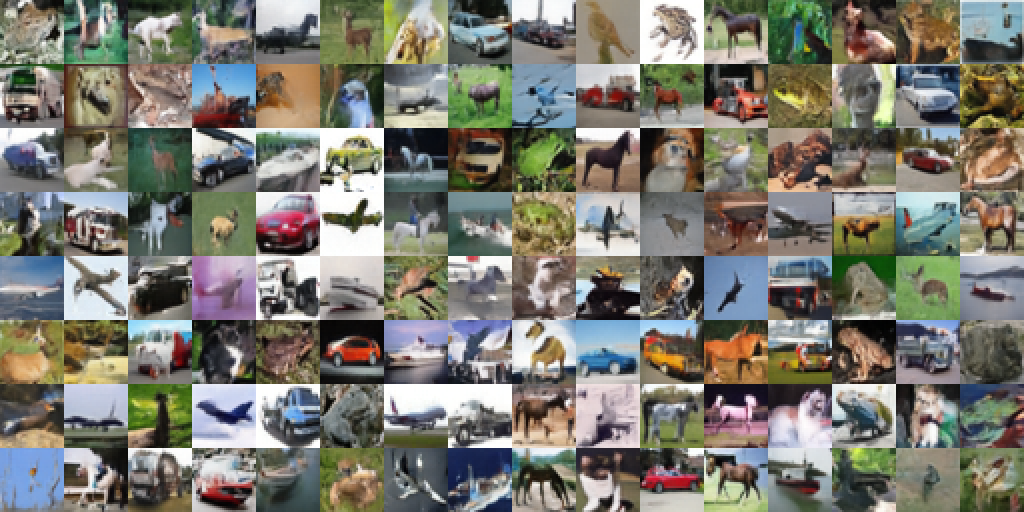
A one-step generator that reaches FID 13.17 on CIFAR-10 with no
pretrained network anywhere in training, and a separate machine-checked
proof of the assumption the whole method rests on.
Encoder-free drifting
Drifting identifiability
Sep — Dec 2025
Directed Reading Program
Mathematics research · UC Berkeley · Mentor
Thomas Browning
- The program
-
Berkeley’s DRP pairs an undergraduate with a graduate student
mentor for a semester of independent reading, meeting weekly and
ending in a written paper and a talk to the department.
- What I did
-
Read a 2012 paper on filters in real analysis, then learned Lean 4 and
Mathlib in order to check it. Restating convergence and continuity in
filter language and getting each proof past the checker was most of the
work, and the part that taught me the most: it is where you find out
whether you understood a definition or only recognised it.
- What came out
-
A paper and a single Lean file of seven verified results, presented at
the end-of-semester session to the mathematics department.
Real analysis with filters
What carried over
The reading program was pure mathematics and had nothing to do with machine
learning. What it left me with was Lean.
Eight months later that turned out to be the useful thing. Drifting stops
training when a certain field reaches zero and treats that as evidence the
model has learned the data — but nobody had proved it. If two different
distributions could cancel each other out, a model could report a perfect
loss and be wrong, with nothing in the training loop able to tell. Writing
that proof was only an option because a semester on filters had already
taught me the language and the library it needed.
It also changed how I read the machine learning papers. Formalizing an
argument makes you notice which steps are actually established and which
are being waved through, which is the habit that found the gap in the first
place.